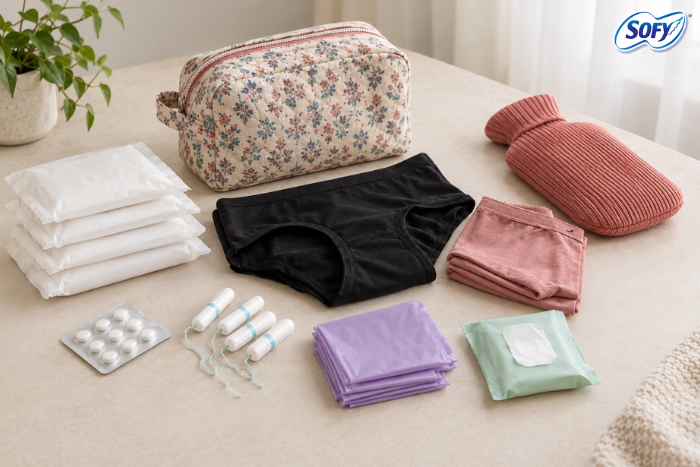

A working period storage system covers three things: a main stock kept somewhere dry, products sorted by flow level and situation instead of brand, and a small grab-and-go kit for when you’re away from home. Period products stored this way are faster to find, last longer, and cut down on the mid-cramp scramble through three different drawers.
Quick Reads
- A complete period storage set-up covers more than pads and tampons; it should also include spare underwear, pain relief you’d actually reach for, disposal bags, and wipes for the version of your kit that leaves the house
- Unopened pads and tampons are generally safe for three to five years, but bathroom humidity from regular showers speeds up mould risk and shortens that window, so your main stock is better off somewhere dry
- Bacteria on used period pads can multiply up to 512 times within three hours, which is part of why fast, uncomplicated access matters just as much as tidy storage
- Sorting by flow level and situation, light days, heavy days, overnight pads, and on-the-go, tends to work better than sorting by brand or product type, since it matches how you actually reach for things under pressure
- A separate grab-and-go kit for your bag, car, or desk covers the days your main stock isn’t with you, and it’s worth restocking the same day you use anything from it
Search this topic, and most results say the same thing: get a box, add some dividers, done. That treats organising as a decorating problem, when it’s really a planning one. A set-up that actually works starts with three decisions. What belongs in the kit? Where it should live so it survives more than a few months. And how it’s grouped so you can find the right thing without having to think. This guide walks through each one in order.
What Belongs in a Complete Period Kit?
Let’s start with the obvious stuff: pads, tampons, period underwear, that’s your core. But a kit that’s actually useful goes further than that. Throw in a spare pair of regular underwear, some pain relief you’d actually take, a few small disposal bags, and a cleansing wipe or two. Get cramps? Toss in a hot water bag or heat patch too, because that’s exactly the thing you’ll be scrambling to find at the worst possible moment otherwise.
These are the items people always end up hunting for separately, mid-cramp, which kind of defeats the whole point of organising in the first place. And don’t overdo it; keep quantities realistic. Two or three days of your heaviest-flow product, about a week of regular, and a couple of spares of everything else. That covers most cycles without turning your drawer into a full-blown stockroom.
Where Should Your Main Stock Actually Live?
Somewhere dry, ideally. Unopened pads and tampons are generally safe for three to five years, but that shelf life shortens with moisture, and bathrooms are the most humid room in most homes. That’s why a bedroom drawer or hallway cupboard tends to hold up better over time than an open basket catching steam from every shower.
Keep a small amount of period products in the bathroom for daily convenience if that’s easier; just don’t make it the only copy. A closed container beats an open one here, since it limits both moisture and dust. If the bathroom is genuinely your only storage option, a container with a silica gel packet inside, the kind that comes with new shoes or electronics, can help absorb some of the ambient humidity between uses.
How Should You Sort What You Have?
By flow level and situation. Your flow and your day decide what you’ll reach for, so grouping products around those two things means the right category is always in front, not buried behind items you don’t need yet.
| Category | What Goes Here | When You’ll Reach for It |
| Light and regular days | Standard pads, regular tampons | Most of your cycle |
| Heavy flow days | High-capacity period pads, period panties | Your busiest, least patient days |
| Overnight | 360-degree leakage protection panties, overnight pads | Lying down for six to eight hours |
| On the go | Individually wrapped pads, spare underwear, disposal bags | Your bag, car, or desk drawer |
This groups your heaviest-day products in one place instead of scattered across a drawer between things you rarely reach for on those days. It also makes restocking simpler, since you can see exactly which category is running low without having to count through the whole drawer. Clear pouches or open-top boxes work better than opaque ones for this reason, since a glance tells you what needs topping up before you’re actually out.
What Goes in a Grab-and-Go Kit?
A pouch small enough for a bag, glovebox, or desk drawer, packed separately from your main stock. It matters most for the day your period starts earlier than expected, since that’s rarely a day you’re near your main supply.
Sync the restock with your cycle rather than waiting until the kit is empty. Checking it at the start of each cycle, even on months you never open it, means it’s never running on what’s left over from three months ago. Individually wrapped products also hold up better here than loose ones, since a bag collects dust, keys, and the occasional spilt coffee, all of which can compromise packaging that’s already been opened once.
Keep the contents minimal enough that you’ll actually carry it, rather than a scaled-down version of your entire drawer.
What to pack:
- Two higher-absorbency period pads or a spare period panty
- A spare pair of regular underwear
- One or two disposal bags
How Do You Organise Around a Shared Bathroom?
Separate, labelled sections, that’s the fix. Give everyone their own pouch or drawer, and suddenly nobody has to ask, and nobody’s stuck discovering the last one’s already gone right when they need it most. This matters especially with housemates, or a parent and teenager figuring this whole thing out together for the first time.
And you don’t need anything clinical here. Colour-coded pouches, a bit of washi tape with initials scrawled on it, whatever lets you glance and know instantly, way easier than trying to remember some system. One more tip: keep a small shared “backup” stash separate from everyone’s personal supplies. That way, borrowing in an emergency doesn’t quietly wipe out someone else’s kit without them even knowing.
A small closed basket in the guest bathroom, restocked every couple of months, handles visitors without anyone needing to ask. It’s one of the reasons we keep Sofy’s packaging clearly labelled and easy to tell apart at a glance, so a shared basket like this doesn’t need its own separate sorting system to stay usable.
How Do You Keep the System From Falling Apart?
Most storage setups don’t fail due to bad design. They fail because nobody checks them, and a system that isn’t reviewed slowly turns back into the pile it started as. A short routine, done once a cycle, is usually enough to keep it working.
- Check your main stock at the start of each cycle, not just when you’re already low.
- Restock the heavy-flow section first, since it tends to run out fastest.
- Refill your grab-and-go kit the same day you use anything from it.
- Move older packs to the front so nothing sits untouched for years.
- Discard anything with damp, torn, or discoloured packaging, regardless of age.
None of these steps takes more than a few minutes, and doing them at the same point in your cycle each time turns the whole routine into a habit rather than a task.
Conclusion
Let’s be real, a tidy-looking drawer and a system that actually works are two completely different things. Build yours for the version of you who’s rushing out the door, doubled over with cramps, or just caught totally off guard. Stock it right, keep it dry, and give it a quick check once a cycle. You shouldn’t have to dig, guess, or scramble. That’s the whole idea behind every Sofy pack. And honestly, your whole setup deserves that same kind of ready-when-you-need-it energy.
Frequently Asked Questions
2. Where's the best place to store period products long-term?
Somewhere dry works best, since humidity shortens shelf life, not time on its own. A bedroom drawer or hallway cupboard holds up better than a bathroom cabinet, though keeping a small amount in the bathroom for daily convenience is also fine.
3. How do I organise period products in a shared bathroom?
Separate labelled sections or pouches per person work best, so nobody has to ask, and nobody runs out without warning. Colour-coded pouches or a strip of tape with initials is usually enough, and keeping a small shared backup stock covers emergencies well.
4. What should always be in an emergency or on-the-go kit?
At minimum, restock one higher-absorbency pad or period panty, a spare pair of underwear, and a disposal bag the same day you use anything from it. Individually wrapped products, like Sofy's, tend to hold up better here than loose ones, since they're less exposed to whatever else is rattling around in your bag.
5. How long do unopened period pads and tampons actually last?
Generally, three to five years if stored properly, though moisture exposure in humid rooms like bathrooms can shorten that considerably. Checking for damp patches, discolouration, or a broken seal is a more reliable indicator than the date alone.
6. How often should I check and restock my supply?
Once a cycle is a reasonable habit, ideally at the same point each time, it becomes routine rather than something you have to remember. Check your heavy-flow section first, since it tends to run low fastest, then work through the rest of your set-up.
