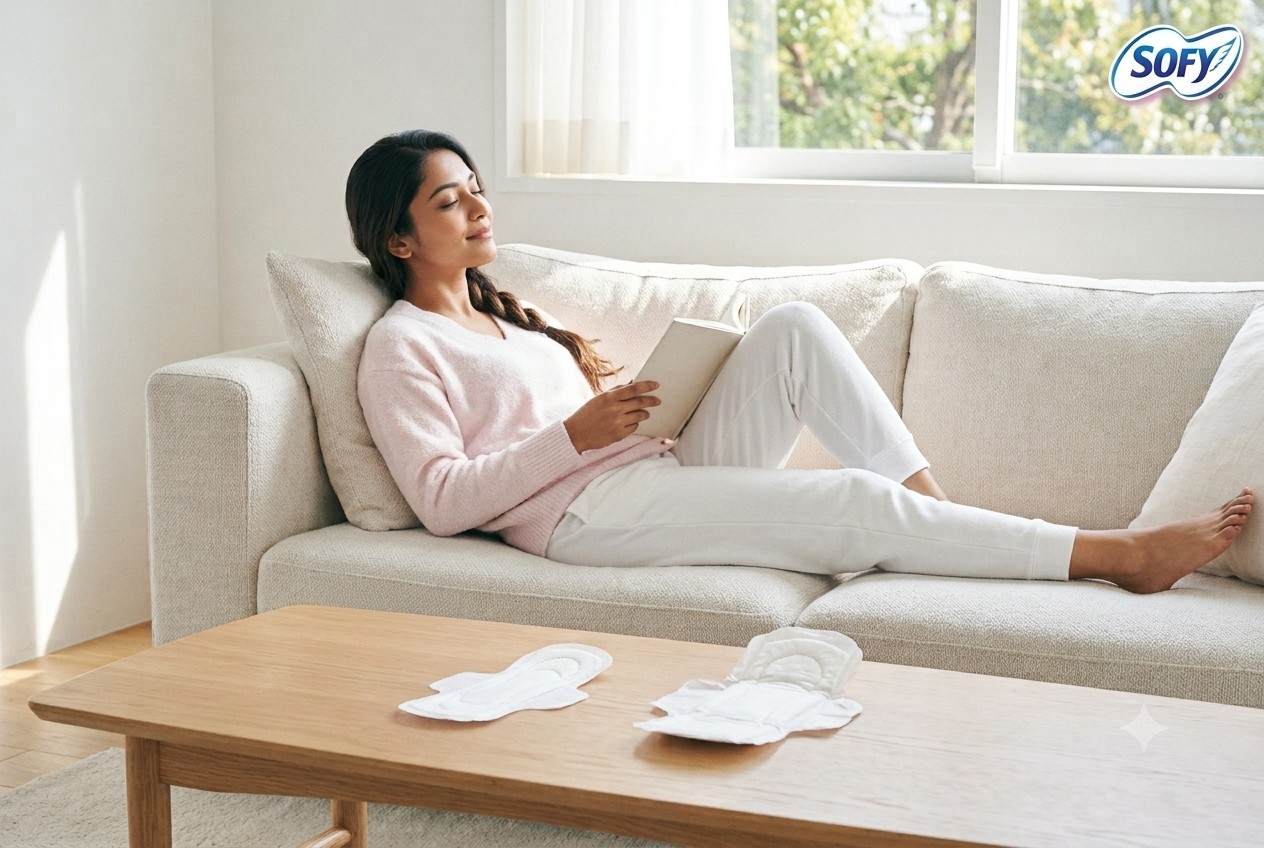

Pad thickness has less to do with protection than most people assume. Soft sanitary pads built around a dense absorbent core hold as much fluid as bulky ones while staying slim, breathable, and less likely to cause rashes. What protects you on a heavy flow day is core density and how often you change your pad. Thicker pads simply trap more heat and friction, the two biggest triggers behind period-related skin irritation.
Quick Reads:
- Height and capacity aren’t the same thing. A slim pad built around a dense SAP core can absorb more than a bulky one, so “thin” is not automatically “less protection”
- That raw, itchy patch on your inner thigh by evening almost never comes from choosing a thin pad. It comes from a damp pad sitting against skin for too long, usually past the 4 to 6 hour mark
- Panty style sanitary pads (Period Panty) work through wider back and side coverage, not extra padding, which is why they hold up on long, high-flow days without adding bulk you can feel
- Changing your pad every 4 to 6 hours does more for your skin than switching brands, upgrading thickness, or trying a new material ever will
- A cloth-like, breathable top sheet stays noticeably cooler against skin than a plastic-feel one, even when both pads are the exact same thickness, which matters most in peak summer or on a non-AC commute
There’s a specific kind of discomfort that doesn’t get talked about enough: the tiny, constant shift in your chair mid-meeting because the pad’s bunched up somewhere it shouldn’t, or standing on a crowded metro at 6 pm in June feeling a moist patch spread with no way to fix it until you’re home. Most of us picked our pad thickness once, years ago, on nothing more than “thick feels safer,” and never questioned it again.
That instinct isn’t wrong exactly, just outdated. Pad technology moved past “more padding equals more protection” a while back, and thickness stopped being a reliable signal for either safety or comfort. What actually decides whether you’re comfortable by 6 pm has almost nothing to do with how the pad looked in the pack.
What Is Pad Thickness, Really?
Pad thickness refers to the physical height of the absorbent core sitting between the top sheet and the base layer. It has nothing to do, on its own, with how much fluid the pad can actually hold. Thin, soft sanitary pads can carry a dense super-absorbent polymer (SAP) core and absorb twice as much fluid as a thick, old-style cotton-pulp pad twice its height, which is exactly why the ultra-thin pads sold today often perform better than the “maximum protection” bulky ones from a few years back.
The confusion is inherited, honestly. For decades, more cotton or pulp was the only way to add absorbency, and bulk came along as a side effect. Once SAP technology arrived, that link broke, but the shelf habit of reaching for “thick equals safe” stuck around anyway. India’s sanitary napkin standard, IS 5405, tests absorbency by how much fluid a pad retains under pressure, not by how tall it stands, which is where the real measure of protection lies.
How Does Pad Thickness Affect Comfort?
Comfort on your period comes down to two physical things: how the pad moves with your body, and how much heat and moisture it holds against your skin while doing it. A thicker pad sits more rigidly no matter how well it’s made, which means friction with every step, every time you sit at your desk, every time you cross your legs on a long car ride. That friction doesn’t announce itself early. It’s fine in hour one, mildly annoying by hour three, and by hour six it’s the reason you’re wincing slightly when you finally sit down at home.
A thinner pad with a soft, cloth-like top sheet bends with your body instead of resisting it. It’s part of why soft sanitary pads with a contoured shape disappear from your awareness faster than flat, thick alternatives; less surface friction means less to notice by evening. We built Sofy’s period pads on that exact trade-off: absorbency handled by the core, comfort handled by the surface.
A 2025 survey of Indian women found that about 62.7% reported skin irritation linked to pad use, mostly tied to wearing a single pad well past the recommended 4 to 6 hours. Time against skin, not thickness, decided the outcome in that study, and it usually does in real life too.
Are Thin Pads Enough for Heavy Flow?
This is the one we hear on repeat, almost always from someone bracing for a “no.” It isn’t. What decides whether a pad handles heavy flow is how the absorbent core is laid out: wider coverage at the back for overnight, a broader central zone for daytime, and a SAP core dense enough to pull liquid away from the surface fast, before it has time to sit and cause trouble.
Panty style sanitary pads make this obvious in practice. Rather than relying on thickness for capacity, they wrap coverage around the whole body, cutting side leakage without piling on bulk. Picture a heavy-flow day stuck in back-to-back meetings with no time to check the mirror between them; that combination of full coverage and a slim profile holds up far better than a thick pad shifted an inch to the left by lunchtime.
How to Choose the Right Pad Thickness for You?
Someone with a consistently heavy flow who switches from standard thick pads to slim, high-density soft sanitary pads with wider back coverage almost always reports fewer leaks at the edges afterward, simply because the coverage area increased even as the pad got thinner.
Forget defaulting to whatever pack looks thickest on your heaviest day. A few things are worth checking instead:
- Look at the absorbency rating on the pack, usually printed in milliliters, instead of trusting the word “thick” or “thin” on the front.
- Match the pad’s length and coverage to your flow pattern rather than its volume: wider back coverage for overnight, a focused central zone for daytime.
- Pick a breathable top sheet if you’re prone to irritation; it matters far more here than core height ever will.
- Change your pad every 4 to 6 hours regardless of how full it looks, since the damage is done by time, not by volume.
- Keep a thin, high-absorbency pad as your everyday default, and save anything bulkier for overnight, and only if you genuinely need the extra length.
Conclusion
Next time you’re standing in front of that wall of pads, skip the instinct to grab the thickest one out of habit. Check what’s inside and how it moves with your body through a real day. A well-designed slim pad, built on the right core density with a breathable surface, beats a bulky one in both protection and comfort by evening. Your skin usually notices before you consciously do.
Why do I get rashes only on certain pads?
Rashes are usually caused by trapped moisture, friction, or ingredient sensitivity (fragrance, adhesive, synthetic fibers), not the pad's thickness.
Are panty style pads suitable for heavy flow?
Yes. Panty style soft sanitary pads for heavy flow are designed with extended coverage around the body, which often reduces side leakage better than added thickness does.
How often should I change my pad to avoid irritation?
Change every 4 to 6 hours, regardless of how full the pad appears, since prolonged contact with moisture is a key factor in skin irritation.
Do soft sanitary pads cost more than regular ones?
Not necessarily. Pricing depends on the brand and core technology used, not the softness of the top sheet, so it's worth comparing absorbency ratings rather than assuming softer means pricier.
Can I use a thin pad overnight?
Yes, as long as it has adequate back coverage and a high-absorbency core. Length and coverage area matter more overnight than overall thickness.