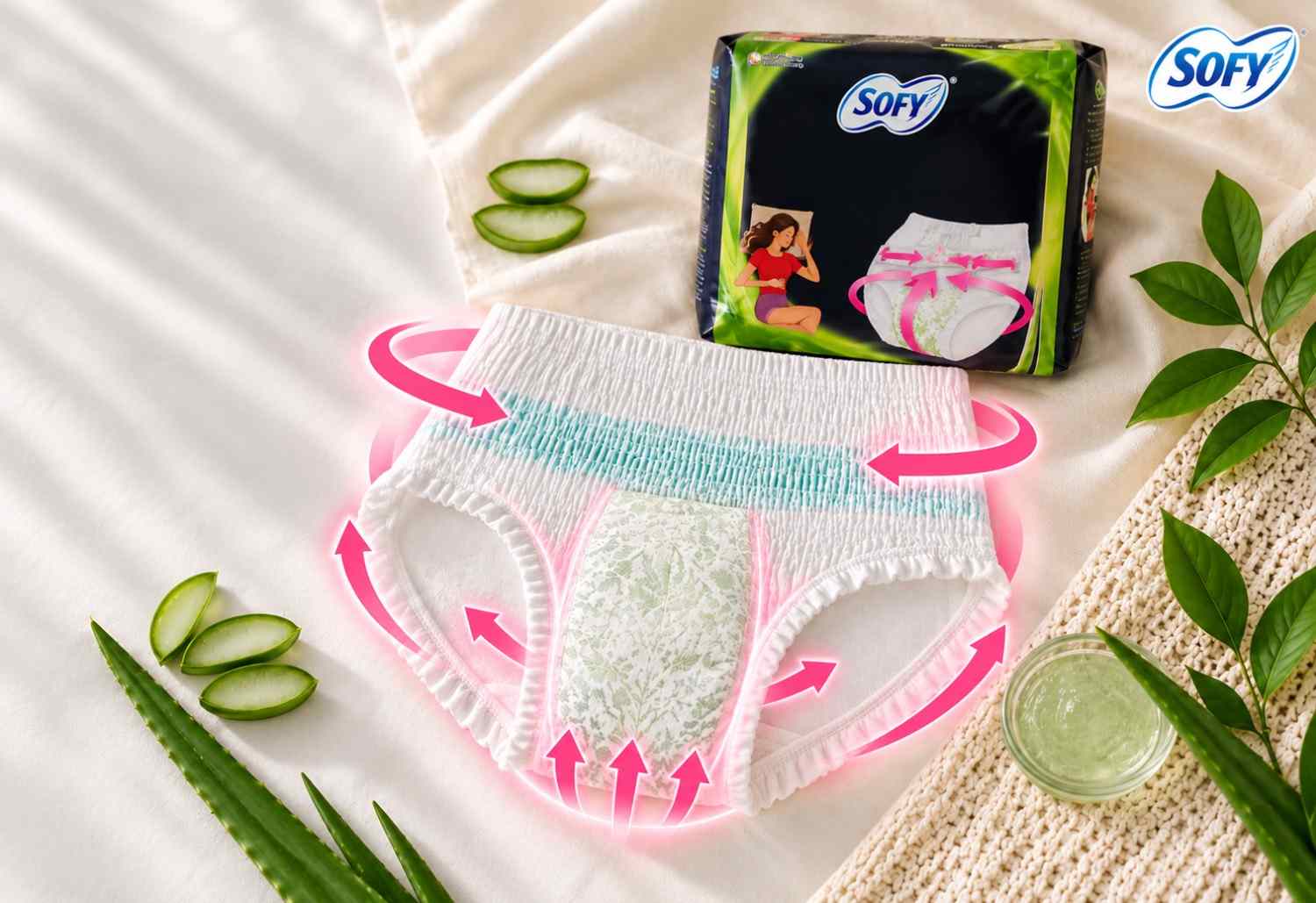

Period panties stop leaks through a layered fabric system, usually four layers, that pulls fluid away from the skin, holds it inside an absorbent core, and blocks it from passing through a leak-proof barrier. 360° absorption means this protection covers the front, back, and both sides of the gusset, not just the center.
Quick Reads
- Leak protection comes from four stitched layers: a moisture-wicking top layer, an absorbent core, a leak-proof barrier, and an outer shell.
- 360° absorption covers the entire gusset, front to back and side to side, closing the gap a regular pad leaves open
- BIS standard IS 17514:2021 governs period panties sold in India, made mandatory under the Medical Textiles (Quality Control) Order, 2024
- Overnight and heavy-flow panties typically absorb 40 to 50 ml, close to two or three regular daytime pads
A stained sheet at 3 a.m., a spare change of clothes packed just in case, a pad that shifted sideways during a two-hour commute. These are the specific moments that send women searching for something that actually holds. Period panties promise to fix that exact failure point, but terms like “360° protection” or “zero-leak design” rarely explain what is actually happening inside the fabric. We want to show you the real construction behind that promise, not just the marketing language around it.
What Are Period Panties?
Period panties are underwear built with an integrated absorbent core. That core collects and holds menstrual fluid on its own, without a separate pad, tampon, or cup. These fall into several categories, with disposable being one of them. Each uses a different absorbent core and serves a different use case, so “period panty” is not a single product but a category with real variation.
360-degree leakage-protection panties look like ordinary underwear from the outside, but the similarity ends at the waistband. The difference sits in the gusset, the panel between the legs, where several fabric layers do the actual work.
What Does 360° Absorption Actually Mean?
You might be wondering what we even mean by 360° absorption in disposable period panties. It refers to an absorbent core and leak barrier that cover the front, back, and both side panels of the gusset. This differs from a standard pad, which mainly protects the central strip where the adhesive runs, usually 15 to 20 centimeters down the middle of the underwear.
When women sleep on their side, have cramps, or move during the day, fluid can travel sideways past that strip. A 360° gusset closes that gap. The entire seat of the panty becomes part of the absorbent zone, not just the center.
How Do Period Panties Stop Leaks?
Leak prevention doesn’t happen in one step. It is a sequence, and each layer has one job before passing fluid to the next. Most 360° leak proof panties for periods use a four-layer build inside the gusset. Here is how fluid moves through it, from the moment it touches fabric to the moment it is sealed in:
- Top layer (moisture-wick layer): Usually cotton or a cotton-spandex blend. It sits against the skin, feels dry within seconds of contact, and pulls fluid downward instead of letting it sit on the surface
- Absorbent core layer: Made of microfibre or a cellulose-based pad. This layer holds the bulk of the fluid, often 20 to 50 ml depending on the size and flow rating.
- Leak-proof barrier layer: A thin, breathable membrane, commonly TPU (thermoplastic polyurethane), stitched beneath the core. It blocks fluid from reaching your clothing. Air can still pass through it, so it skips the damp, clammy feeling of plastic-backed pads.
- Outer shell layer: The visible fabric, styled to look and feel like everyday underwear, with reinforced side seams that hold the inner layers in place through movement.
This four-step sequence separates leak-proof panties from underwear with a pad simply placed inside it. Each layer is stitched to work with the one above and below it, so fluid never has a straight path back out.
Why Do Regular Pads and Everyday Panties Fail Where 360° Design Succeeds?
Leaks rarely happen because a product has too little absorbent material overall. They happen because fluid reaches a spot the product was never built to cover.
| Protection point | Regular pad + everyday panty | 360° period panty |
| Centre coverage | Strong, adhesive-backed | Strong, stitched into the gusset |
| Side coverage | Weak, gap between the pad edge and the panty fabric | Continuous, no gap |
| Back coverage during sleep | Depends on pad length and sleeping position | Built into the rear gusset panel |
| Movement resistance | Pad can shift, bunch, or slide | The absorbent core is fixed to the fabric |
| Feel against the skin | Plastic backing can feel damp | Breathable TPU membrane |
A pad’s protection is only as wide as the pad itself. Everyday underwear was never built to be part of the barrier system. So, once fluid reaches the fabric edge outside the pad, nothing stops it. A 360° period panty removes that boundary, acting as a barrier & not an inserted product.
How to Choose a Period Panty for True 360° Protection
Not every product labeled “360°” delivers full gusset coverage. Use this checklist before adding one to your cart.
- Confirm the absorbent core runs the full length of the gusset, not just the center 15 cm
- Verify the leak barrier material (TPU is breathable; plain PU coating traps heat)
- Match the absorbency rating (light, medium, heavy, overnight) to your actual flow, not the highest number available
A product that fails even one of these checks is more likely to protect only the center panel, regardless of what the packaging claims.
How to Keep Disposable Period Panties Working as Intended?
Disposable doesn’t mean zero effort. A few small habits before, during, and after wear can make the difference between reliable protection and an unexpected leak.
- Before wear: Store unopened packs somewhere cool and dry, away from sunlight or humidity. Don’t crush the packaging; it can compress the absorbent layers and reduce their capacity.
- Fit matters: Use Sofy’s hip measurement size chart, not your regular underwear size. Too tight shifts the absorbent core; too loose breaks the leak-proof seal at the edges.
- During wear: Stick to the recommended wear time, usually 6 to 12 hours, and change sooner on heavy days. Let them settle for a minute after putting them on before moving around a lot, and remove them before swimming or showering since they’re not made for water submersion.
- Disposal: Roll used ones inward, secure with the waistband, and bin them. Never flush, even “biodegradable” versions, since most plumbing systems can’t break them down.
- Travel or long days: Pack an extra pair, carry disposal bags, and keep spares away from heat, like a car dashboard, so the materials don’t degrade.
- Skin care: If irritation shows up, size up for airflow, change more often, or try a different brand, since materials vary.
The Takeaway
If you are searching for the best disposable period panty for side sleepers with a heavy flow, the checklist above narrows it fast. When comparing Pads Brands, Sofy’s overnight products with this exact anatomy of movement in mind. A disposable panty that covers the full 360° of the gusset and carries a verifiable compliance statement will outperform one that only sounds impressive on the label.
Frequently Asked Questions
Can period panties be worn without a backup pad or cup?
Yes, for most flow levels. However, many users still pair a backup product on the heaviest day or two. That is a personal precaution, not a product limitation.
How is 360° absorption different from a standard "long" sanitary pad?
A long pad extends coverage front to back but is still only as wide as the pad itself, so side leakage is still possible. 360° absorption extends the barrier across the width and length of the gusset, closing the side gap a pad cannot cover.